RECAP: Designing the human + agent consultancy: Moving from AI adoption to operating advantage
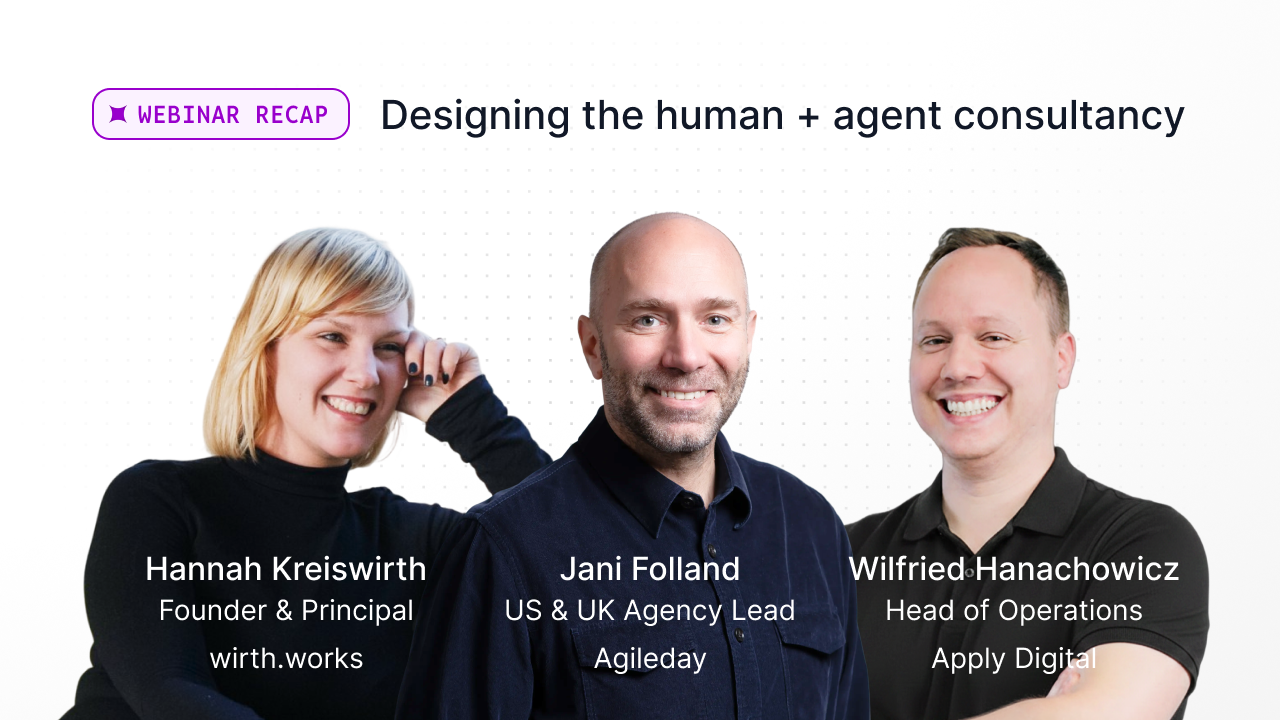
In our latest webinar, Designing the human + agent consultancy: Moving from AI adoption to operating advantage, Jani Folland (US & UK Agency Lead, Agileday), Hannah Kreiswirth (Founder & Principal, wirth.works), and Wilfried Hanachowicz (Head of Operations, Apply Digital) explored what actually changes when AI and agents become part of delivery, operations, and organizational design.
Watch the replay.
The discussion moved beyond tool adoption and into the practical realities agencies and consultancies are now facing: how roles evolve when agents take on more execution, why operational guardrails matter, what happens to pricing and staffing models, and how firms can avoid simply accelerating existing dysfunction.
At Agileday, we believe the next competitive advantage in professional services will not come from AI usage alone. It will come from intentionally designing workflows, operating models, and organizations where humans and agents can work together effectively.
As Hannah Kreiswirth put it during the discussion, the real challenge is not simply implementation:
“We’re kind of treating AI transformation as a technology implementation problem when it’s actually an organizational design problem or a business problem.”
If you missed the session, here is a recap of the key themes and insights from the discussion.
The problem: high AI usage, low transformation
AI usage is already common. The Spark Report: From Activity to Advantage, 2026, indicates that 80% of staff use AI weekly in some form, but much of that activity remains experimentation with tools rather than sustained operational change. A major risk emerges when usage is ungoverned: it details that over 50% of AI usage is described as unauthorized and lacking systems or instructions. In addition, only 15% of people are characterized as true power users, creating uneven capability across teams.
This pattern helps explain why organizations can simultaneously be “using AI” and still not feel transformed. Localized wins occur, but they do not reliably become shared practices. Teams often reinvent the same solutions in parallel, paying a daily “reinvention tax” when improvements are not captured and distributed.
Reframing AI transformation as an organizational design problem
AI transformation is frequently treated as a technology implementation problem. The more durable framing presented is that it is an organizational design problem and a business problem, with technology implementation as only one part of the equation.
A three-layer model introduced by wirth.works clarifies where organizations tend to stall:
Layer 1: Tools
This layer includes adopting AI platforms, copilots, and agents. Most organizations are active here, often through bottom-up adoption. People who use the tools tend to keep using them, and experimentation spreads quickly.
Layer 2: Workflows
This layer focuses on redesigning how work gets done with AI. Fewer organizations reach this stage consistently. Without workflow redesign, automation wins remain localized: one person may automate a four-hour task, but adjacent teams may never learn about it and will recreate the same approach independently.
Layer 3: Organizational design and business model
This layer involves rethinking roles, decision rights, business models, and culture, including what the organization is built to offer. Very few organizations are described as having reached this layer, even though it is positioned as the most crucial for real transformation.
The core issue becomes a mismatch between “layer one thinking” (which tools to implement) and “layer three thinking” (who the organization is trying to become, and what leverage it intends to create with AI).
What changes when agents enter the organization
Agents do not automatically “clean up the mess” inside an organization. When layered onto unclear structures, undocumented workflows, and institutional knowledge trapped in people’s heads, agents can amplify chaos, confusion, and dysfunction. In that context, the result is not transformation but dysfunction running faster and at greater scale.
Risks to people and performance
Several human risks are identified when agents are introduced without redesign:
- AI “brain fry” from intense AI workflows.
- Context switching overload.
- Quiet erosion of human judgment when people rubber-stamp outputs they increasingly trust.
Operationally, a key constraint is that AI can run many threads in parallel while the human brain functions like a single-threaded processor. Assigning consultants multiple agents across multiple client contexts increases oversight burden and forces repeated context reloading, which is described as a silent killer of productivity.
Wilfried Hanachowicz described this operational risk:
“AI can run dozens of threads in parallel, and that can scale exponentially. But we have to design for a fundamental reality, which is that our human brain is a single-threaded processor. When we give consultants five different agents to manage across five different client contexts, we are not just increasing their capacity, we are multiplying their oversight burden. Every time an agent finishes a task, that consultant has to reload a new context in their head. And we know what context switching does. It’s a silent killer of productivity.”
The opportunity: freeing humans for human work
A different possibility emerges when execution shifts toward agents and organizations redesign roles intentionally. AI handling more execution can create space for work that only humans can do: judgment calls, client relationships, creative leaps, and strategic thinking that have been squeezed by “doing more with less.”
This shift is associated with role innovation, including orchestration roles described as conductors or guides who coordinate AI and human collaboration. The organizations getting this right are described as building a better organization for people, not only adding efficiency.
Approach: guardrails, trust, and “single context” operating design
Transformation depends on leadership enabling safe experimentation rather than issuing heavy top-down mandates that become obsolete quickly in a fast-moving field. The leadership role is framed as providing training and guardrails that allow experimentation to happen safely, while building the connective tissue that turns local wins into institutional wealth.
Guardrails to prevent burnout and protect focus
Operational guardrails are positioned as critical to protect people’s focus and prevent burnout. One concrete guardrail is moving toward a single-context environment. Instead of one person managing multiple agents across multiple projects, multiple specialized agents can operate within the same client context—for example, one handling financial analysis, another drafting a weekly report, and another building a project plan. This reduces context switching and enables the human to act as a true conductor within one coherent environment.
Trust as the foundation of human-agent collaboration
The human-agent relationship is described as needing to be based on trust, especially because LLMs can hallucinate and create a sense of betrayal. Selecting AI models and foundations that align with the integrity expected inside the organization is presented as a way to reduce the need for constant double-checking and validation.
As trust improves, the human role shifts from supervision to amplification. Agents handle menial and redundant tasks, while human value is defined by uncompromised judgment and unique perspective that turns fast results into strong outcomes.
Building an adaptive organization: autonomy, experimentation, and a “second brain”
Adaptability is framed as a cultural and organizational design outcome, not something technology creates on its own. Adaptive organizations are described as having clarity about where they are going, resources that teams can access easily, and authority distributed so team members can make decisions and try new things without waiting for permission. Hierarchical, permission-heavy structures are positioned as increasingly unworkable.
The “second brain” and the connective tissue problem
A practical mechanism for adaptability is building an organizational knowledge base that functions as a “second brain.” Traditional knowledge bases in agencies are described as graveyards because they require heavy manual curation and depend on tribal knowledge to connect new projects to past work.
Agents are presented as the missing link because they can synthesize messy, unstructured data such as transcripts and feedback. By using agents embedded in projects to monitor and capture wins from the ground, organizations can distribute those learnings into the workflows of teams starting new projects in real time.
Wilfried Hanachowicz framed this as a fundamental shift in how agencies scale knowledge internally:
“In the past, knowledge bases failed because they relied on massive manual curation and tribal knowledge. But agents are built to take messy, unstructured data — transcripts, feedback, project learnings — and synthesize it. When you capture what your best people are doing and make it the baseline for everyone, that’s how you scale and how you win.”
Commercial implications: staffing, scoping, pricing, and cost volatility
Human + agent delivery changes how work is staffed, scoped, priced, and operated. AI introduces new costs, including token-based expenditure that can rise significantly. Cost control is complicated by the fact that AI stacks can reprice overnight, and deeply integrated models can change terms or sunset.
Why time-and-material becomes unsustainable
As what a skilled person can produce increases dramatically, a business model built on selling hours stops making sense. The risk becomes either underpricing value or charging rates that are difficult to justify. This increases pressure to experiment with value-based or outcome-based models.
Making value-based pricing executable through modular services
Value-based pricing is described as difficult but achievable through iterative movement. A practical step is designing services more modularly: replicatable, composable offerings structured around outcomes rather than effort. Modularization makes value-based pricing more executable because work is chunked into smaller pieces aligned to outcomes.
Commercial redesign is also tied to adaptability. The business model needs enough flexibility to match the acceleration of technology and the uncertainty of tool costs and availability.
Key implications for leadership
AI transformation is positioned as a leadership responsibility that cannot be delegated indefinitely because it touches culture, operating model, and commercial model. Heavy mandates focused on specific tools are described as fragile in a fast-moving field. Leadership effectiveness is defined by enabling experimentation safely, setting guardrails that protect focus, building systems that allow knowledge to flow freely, and being explicit about where AI creates leverage in the organization.
Takeaways that define operating advantage with AI
Operating advantage comes from moving past tool implementation and making explicit decisions about what the organization intends to become with AI. The hard part is defining the leverage AI should create, designing intentionally for the humans inside the organization, and building an adaptive model that can evolve as quickly as the technology.
Solid foundations include selecting models employees trust, setting guardrails to prevent burnout, and creating systems that capture and distribute what works so that local experimentation becomes organizational capability.
For Jani Folland, this is where AI becomes a commercial and operating model question, not just an efficiency play:
“It’s not about being faster or more efficient. You need to define and be very explicit where AI creates leverage in your company. Figure out where that real advantage is, and then build your commercial model around that,” he said.
What comes next
The firms that create long-term advantage with AI will not necessarily be the ones adopting the most tools. They will be the ones redesigning intentionally: aligning workflows, operating models, leadership structures, and commercial models around a future where humans and agents work together continuously.
That means moving beyond experimentation and toward operational clarity. Building organizations that can absorb rapid technological change without burning out the people inside them. Creating systems where knowledge compounds instead of disappearing into isolated wins. And designing cultures that remain adaptive as both client expectations and AI capabilities evolve.
For agencies and consultancies, this is no longer a future-state conversation. It is an operating model decision that should be on the table now.
Watch the replay, connect with Agileday, or get in touch with our guest speakers Hannah Kreiswirth and Wilfried “Wil” Hanachowicz to explore how agencies and consultancies are redesigning operations for a human + agent future
Let the Agiledays begin.