Headless Agileday: Run your business in your AI client

A client pings you for available talent. A project is missing a consultant. You need visibility into all projects delivered for a client. You want an updated financial forecast for your team’s projects for the next quarter. A consultant on the bench needs to find their next assignment. Hours need to be reported on Friday evening. In each of these situations, the data, tools, and workflows already exist in Agileday. But sometimes it's just easier to ask AI instead of opening Agileday. Or, you might want to automate the whole process with your agents.
Agileday MCP enables all that. It exposes Agileday capabilities for you to run your business via AI clients and agents.
The shift is not about having access to more data, but about being able to act on it faster, more consistently, and more conveniently.
Agileday MCP provides 42 tools for users, projects, staffing, and Time reporting
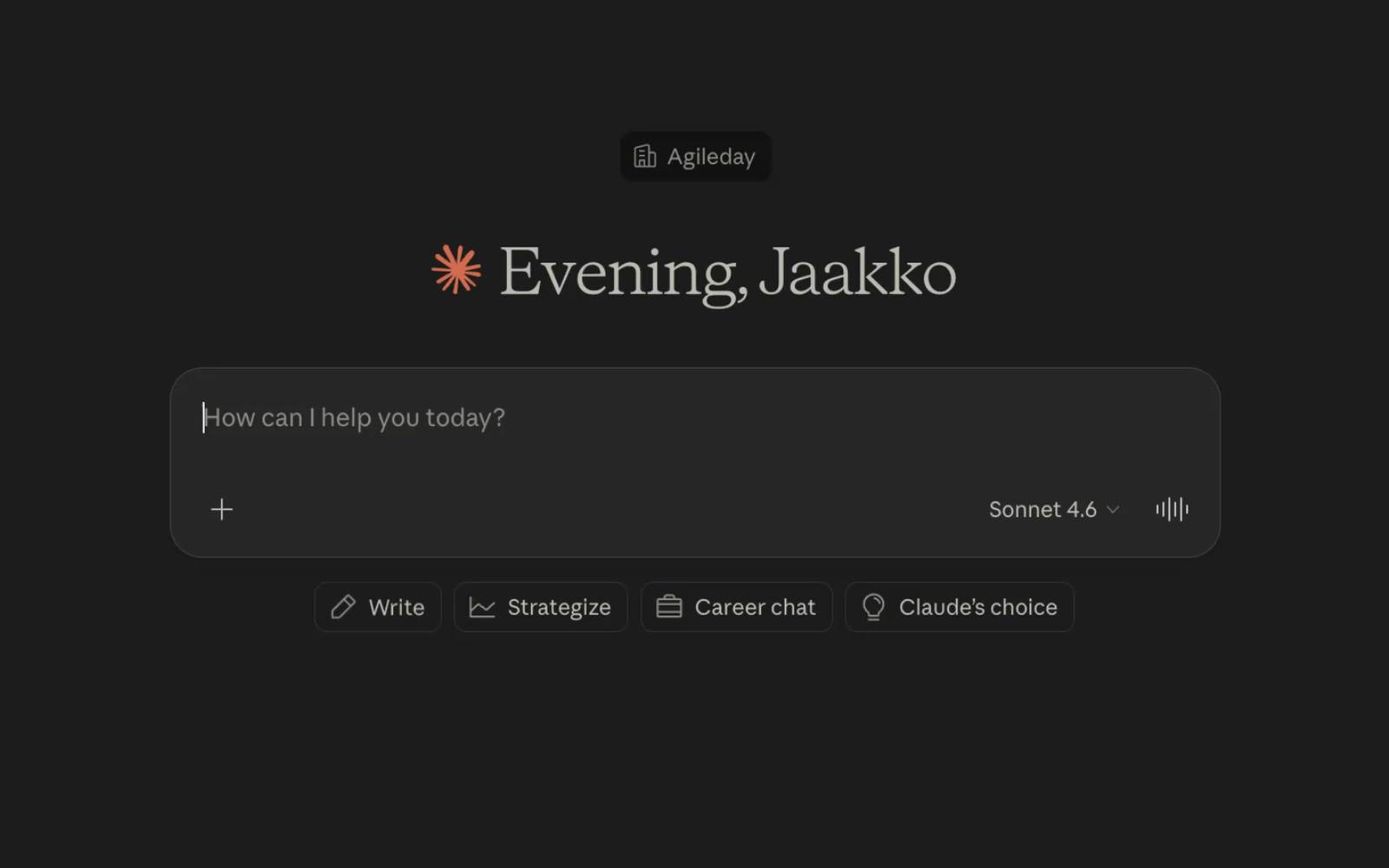
You can now run your business operations where you already work: inside Agileday or through Claude, ChatGPT, or Copilot. Permissions follow the same rules as the platform, so people using the AI client only see what they should.
A user can take a real operational question, enter it into their AI tool, and receive a clear answer based on actual operational data. Better yet, the interaction does not stop at retrieving information — it can also trigger actions such as selecting candidates, generating responses, updating data, or moving a workflow forward.
This isn't a concept or a beta product, but something you can start using in day-to-day work today.
What the MCP series covers
An upcoming series of blog posts focuses on how MCP applies to real situations in various roles across professional services organisations. Each use case is built around a single target, where someone needs an answer quickly and where speed and quality directly affect the outcome of a decision.
As reflected across the different use case areas, this applies to multiple roles within the business. For example, consultants can identify relevant opportunities and maintain accurate skill profiles, staffing teams can understand gaps between demand and supply and act on them, sales teams can respond to client requests with confidence, project and finance teams can track utilization and identify risks, and HR teams can analyze skill gaps and support development decisions. The underlying data remains the same across all of these roles, but the ability to both access it and act on it in the same moment changes how work gets done.
Each use case in this series shows how a common situation changes when AI has direct access to operational context and the ability to trigger actions.
How MCP makes this possible
Agileday already connects the operational core of your business: people and competences, sales pipeline, staffing, projects, time reporting, financials. MCP is the layer that makes all of it accessible to AI in a permission-aware way.
Agileday MCP: Connecting AI clients and agents to real operational workflows
Instead of navigating systems manually, users can interact with operational data using natural language. AI can retrieve the right information, combine structured data such as skills and availability with unstructured data such as experience and project history, and return outputs that are immediately usable. At the same time, these interactions can trigger actions directly, such as creating shortlists, drafting communications, updating records, or progressing workflows without requiring separate manual steps.
For automation and agents, you can also connect your custom agents or Slack bot to Agileday MCP, to run recurring tasks or react to events in your HR, CRM or financial tools. In addition, as more tools adopt MCP, you can build overarching workflows across multiple systems.
What to expect next
Over the next few posts, we're walking through how MCP plays out in the roles where speed actually changes outcomes. Each post in this series takes a real scenario and shows how it changes when operational data is only one prompt away.
- Sales and staffing: Respond to demand faster, optimize allocations, and balance delivery with consultant needs
- People, HR, and time reporting: Simplify operational workflows for consultants while improving skills, reporting, and workforce visibility
- Projects, financials, and billing: Improve operational visibility across utilization, revenue, margins, and project performance
It’s the same data underneath, but different questions on top. The change isn't in what's stored, it's in what you can do with it, right now.
Get in touch to meet our team for a walkthrough to see how the Agileday MCP can reshape how your firm operates.
Let the Agiledays begin.