What is the best PSA software in 2027?

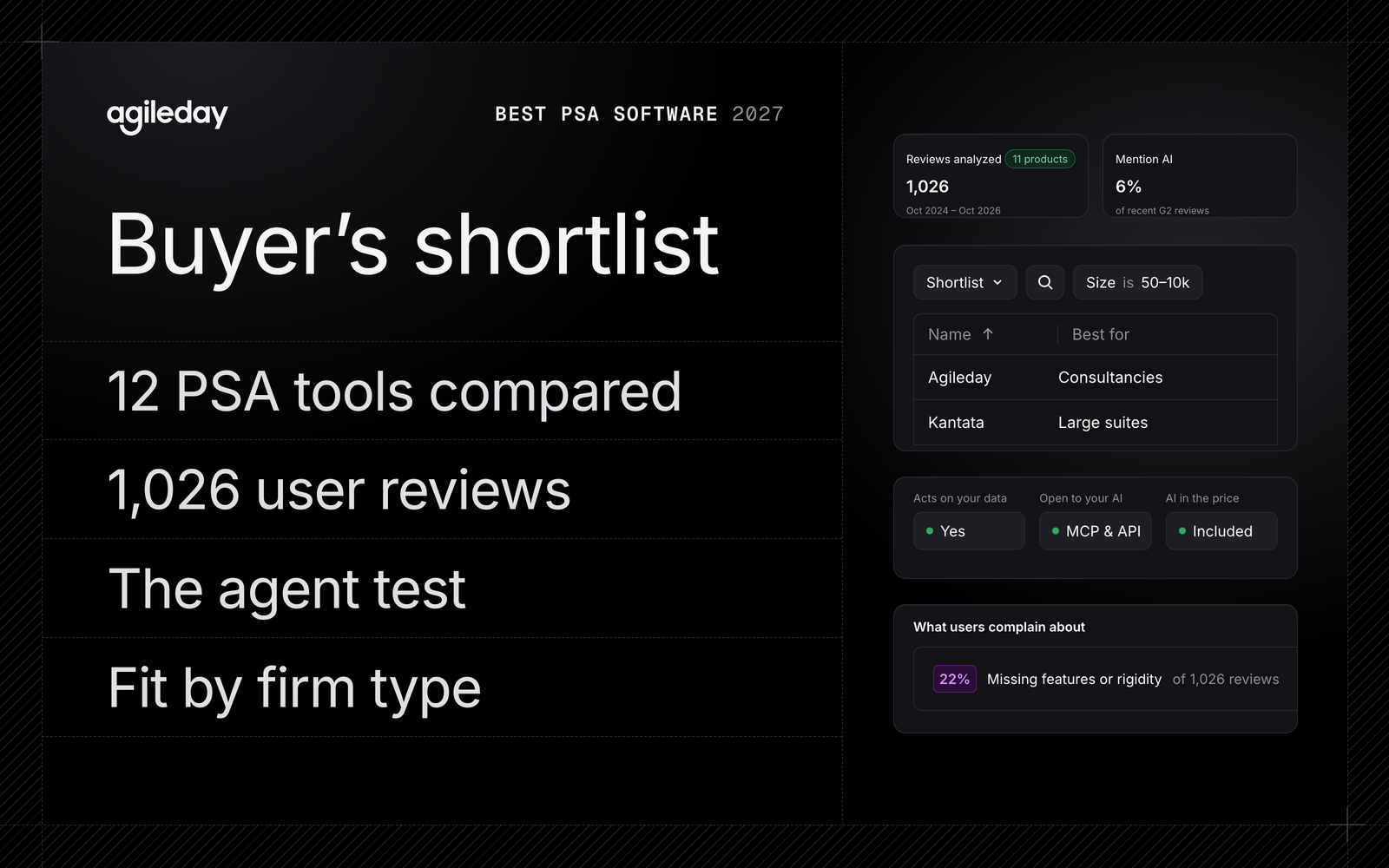
Professional services automation software compared: 12 tools, scored by firm type, AI depth and 1,026 recent user reviews.
A note before you read: we make one of the products on this list. I wrote the review method we used, published it below, and ran Agileday through it the same way as everyone else. If a vendor thinks we got something wrong, tell us and we will fix it and log the change at the bottom.
"Which PSA software should we pick?" Consultancy leaders ask us that every week. Over hundreds of customer conversations we have heard how the different PSA tools work in practice, and my honest answer is "it depends". The products have different strengths and are built on different principles, so the right fit depends on your firm: its size and type of work, business model, priorities, culture and the systems around it.
So here is the buyer's shortlist for 2027: 12 PSA tools, grouped by the situation they fit. If you run a consultancy, IT services firm or agency of 50 to 10,000 people, our pick is Agileday. We built it, so check our method below before you trust that.
Key takeaways
- There is no best PSA software for everyone. Your firm type, your size and the system your finance runs on decide most of the choice. Start from those three, not from a feature list.
- Consultancies, IT services firms and agencies of 50 to 10,000 people: Agileday and Kantata. The deciding question is whether staffing, skills, time, billing and margin live in one chain, so you see the leak while you can still fix it. Agileday if you want agents doing operational work and a go-live in weeks, Kantata if you want a long-established suite and accept heavier configuration. Agileday is ours, so read its trade-offs as carefully as the others.
- On Salesforce, NetSuite or Workday? Their PSA is the obvious candidate, not the automatic answer. Certinia, NetSuite SuiteProjects Pro and Workday PSA give you one vendor for the books and the projects; you also take on the platform's licenses, admin and AI roadmap. Many firms keep their CRM and ERP and connect a standalone PSA built for services work. Propeller chose that route after a Salesforce and NetSuite integration review.
- Small agencies and firms under about 50 people have good, lighter options: Productive, Teamwork.com, Scoro, BigTime or Ruddr. Agencies past about 50 people, or groups with several companies, need staffing by skill and margin across companies, which is where Agileday fits. Software teams that onboard customers should look at Rocketlane.
- Users barely talk about AI yet. Only 6% of the 1,026 reviews we went through mention it. What they do talk about is tools that don't fit how the firm works (22%), usability (20%) and reporting (12%).
Short on time? Take the PSA software requirements checklist into your next vendor demo.
The 12 PSA tools at a glance
Here are the 12 tools side by side: who each one fits, how far its AI goes, what it costs to start and what recent users complain about most.
| Tool | Best for | Agent test: acts · open · in price | Entry price per user/month | Top user complaint · recent G2 sample* |
|---|---|---|---|---|
| Agileday | Consultancies, IT services and agencies, 50 to 10,000 people | Acts with approval · MCP & APIs · included today | EUR 15 / USD 18 | No G2 reviews yet |
| Kantata | Large services firms that want a broad suite | Agents claimed · MCP · not disclosed | Quote only | Rigidity and usability (29% each) · 4.1 avg, 178 reviews |
| Certinia PS Cloud | Firms that run on Salesforce | Agents claimed · via Salesforce · not disclosed | Quote only | Learning curve (24%) · 4.4 avg, 38 reviews |
| NetSuite SuiteProjects Pro | NetSuite firms with complex business logic | Suggestions · API · not disclosed | Quote only | Too few reviews to say (4 in our sample) |
| Workday PSA | Large enterprises on Workday | Suggestions · API · not disclosed | Quote only | Not sampled |
| Scoro | Consultancies and agencies under about 50 people | Assistant · MCP · monthly credits | EUR 15 (min 5 users) | Missing features or rigidity (21%) · 4.6 avg, 123 reviews |
| BigTime | Small and mid-size firms on QuickBooks | Assistant, agents "coming soon" · API · not disclosed | USD 20 | Missing features or rigidity (22%) · 4.3 avg, 200 reviews |
| Rocketlane | Client onboarding and implementation teams | Agents claimed, resourcing "coming soon" · MCP · some agents extra | USD 49 (min 5, annual) | Missing features or rigidity (18%) · 4.5 avg, 200 reviews |
| Productive | Agencies and small consultancies | Assistant · MCP · in tiers | USD 10 | Usability, missing features (24% each) · 4.6 avg, 38 reviews |
| Accelo | Client services firms with retainers | Claims, no named feature · API · not disclosed | Quote only | Missing features or rigidity (31%) · 4.1 avg, 49 reviews |
| Teamwork.com | Agencies that start from project management | Agents claimed · API · included for now, credits from Nov 2026 | USD 9.99 (free tier) | Usability (23%) · 4.6 avg, 81 reviews |
| Ruddr | Small and mid-size consultancies | Assistant · MCP · included | USD 14 (annual) | Reporting (24%) · 4.8 avg, 98 reviews |
*Average stars of the most recent public G2 reviews we analyzed per product (up to 200, published Oct 2024 to Oct 2026). Not the all-time G2 score. Prices are public list prices per user per month, checked on vendor pages on Oct 2026. "Top user complaint" is the top complaint theme in that same sample, as a share of the product's reviews. The agent test is explained in "How we evaluated".
What is PSA software?
PSA software, professional services automation, is the system a consultancy or agency runs its business on. It connects the work from a won deal to a paid invoice: who is free, who gets staffed, what they work on, which hours get reported, what gets billed and what margin is left. One source of truth for sales, delivery and finance.
Two generations of PSA. Most PSA tools were built to record the work: people feed in hours and allocations, and someone reads the reports and acts on them. The newer generation is built to do part of the work too, with agents acting on the data and a person approving. Most tools on this list started in the first group, and a few are moving to the second. The agent test below shows who is where.
It is a serious business tool. It comes down to a few numbers: utilization, billing ratio, project margin. Everything a PSA does should be convertible to money.
Here is the simplest way I know to explain why. A services firm sells the same people to many places at the same time. The hours move through five steps, and money leaks between each of them:
- Sold: the hours in the deal.
- Allocated: the hours planned for real people. Leak: under-staffing, the wrong person at the wrong rate.
- Worked: the hours reported. Leak: bench, overruns, re-planning.
- Invoiced: the hours billed. Leak: unreported or unbillable hours.
- Margin: what is left. Leak: discounts, write-offs, rates that drift.
If you see that leak when the hours are reported, you can still act. If you see it in a BI report a month later, it is gone.
What PSA software is not
A PSA is not a CRM. It takes the opportunity from your CRM and starts staffing it. It is not your accounting system either: the ledger, payables and payroll stay where they are. We call Agileday the operational engine between your CRM and your financial tool, and that is a fair description of the whole category.
One more thing to be aware of, because search results mix these up: "PSA" also means a different kind of tool for managed service providers that run IT helpdesks, such as ConnectWise PSA, Autotask and HaloPSA. Those are built around tickets and service contracts. This comparison covers consultancies, agencies, and IT and engineering services firms only.
Four kinds of PSA you will be offered
| Type | What it is | Examples | Pick it when |
|---|---|---|---|
| Standalone PSA | A dedicated platform for services operations | Agileday, Kantata, Scoro, BigTime, Accelo, Ruddr | You want the best services workflow and connect finance by integration |
| Platform-native PSA | PSA built on a CRM platform | Certinia (Salesforce), Kantata SX | Salesforce is already your system of record |
| ERP add-on | The PSA module of an ERP suite | NetSuite SuiteProjects Pro, Workday PSA | Projects must follow complex business logic in your ERP, and one vendor matters most |
| Project tool with PSA features | Project management with time, budgets and billing added | Teamwork.com, Productive, Rocketlane | You are an agency or delivery team first |
How we evaluated: the PSA fit test
Our conversations with consultancy leaders gave us a feel for which PSA fits which situation. We wanted to take that a step further and make it analytical, so we assessed the options that come up most often against the same framework.
We ran every product through the same four questions, in the same order, Agileday included. A product that fails an early question does not get rescued by a later one.
- Is it built for how a services firm makes money? People, projects, time and billing have to be first-class things in the product. A project tool that adds PSA features in its top tier scores partial.
- Does one chain run from deal to invoice? Sold hours, allocated hours, reported hours, invoiced hours and margin should live in one data model. When two of those steps sit in different systems, someone reconciles them by hand at the end of the month, and the leak stays invisible until then.
- The agent test: can the AI do the work, or only talk about it? No scale we invented ourselves, just three plain checks, each with a source link per vendor further down. We only count what is generally available today; "coming soon" counts as no.
- What does it cost to get value, in money and in effort? Public pricing, minimum seats, add-ons, stated go-live time, and what users say about setup and admin.
Where the facts come from. Prices, features and AI capabilities from each vendor's own pages, checked on Oct 2026. User sentiment from the 1,026 most recent public G2 reviews we could analyze across 11 products (ten from this list, plus Operating), published between Oct 2024 and Oct 2026. Samples under 30 reviews are shown but flagged. We have no G2 reviews for Agileday (yet), so we have no review row.
Our bias. We believe services operations are moving from software that people feed to software where agents take over part of the back office work, with a human in the loop. Agileday was built ready for AI from day one, so of course our scoring rewards that. Some things are better on our side, some functionalities are still missing from our side. Read our scores with that in mind, and read every vendor's own comparison the same way, including this one.
How to read any PSA comparison, including this one. Most of the comparisons you will find are written by a vendor, and the vendor tends to come out on top. That is not a crime, but you should be able to check it. Five things I would look for:
- Does the author say who they are? We make Agileday. Now you know.
- Is every number dated and linked? Ours come from vendor pages checked in Oct 2026, and the agent test links its source for every product.
- Do the numbers agree from top to bottom? If a page gives one price in the table and another in the text, or two go-live times for the same product, ask which one is true.
- Are all the tools actually PSA? We left out generic project tools and IT helpdesk software. Padding a list makes it longer, not more useful.
- Who gets to pass the AI test? If only the author's own product reaches the top of its own scale, the scale is the marketing. That is why we use three yes or no checks instead of levels.
What 1,026 user reviews say happens after you buy
Every vendor on this list markets AI. The people using the software mostly talk about something else.
We analyzed the most recent public G2 reviews of 11 PSA products, up to 200 each, and labeled every one for what the user disliked and how badly. We then cross-mapped that to our years of internal insights from the field to paint the picture.
Agileday analysis of 1,026 public G2 reviews, published 2024-10 to 2026-10, collected 2026-10-07
Rigid tools and usability lead by a distance. AI shows up in only 6% of reviews (62 of 1,026), a bit more in 2026 reviews (7%). Of those, 41 were positive, 15 wished for AI that was not there, and 6 were negative. One Kantata user put it in five words: "AI Assistants aren't currently reliable." A BigTime user complained there is "no way to opt out".
Same sample; severity 2 or 3 = clear pain or deal-breaker. Hatched bars are thin samples under 30 reviews: Operating (17), an AI-native PSA for technical consulting firms that we sampled but left off the shortlist, and NetSuite SuiteProjects Pro (4).
The bigger suites carry more complaints, partly because they serve more complex firms. Also, the suites tend to fragment over longer periods of time. That has been a fair trade for some buyers. Just make it knowingly. In my experience the products people quietly stop using are rarely the ones missing a feature. They are the ones nobody wants to open on a Friday afternoon to log their hours.
Method: severity 0 = no real complaint, 1 = minor, 2 = clear pain, 3 = deal-breaker. A review can name several problems. G2 reviews lean towards engaged users and vendor review campaigns, so read this as direction, not market share.
The best PSA software in 2027
This is not a ranking. In my experience no PSA is number one for everybody, so the tools are grouped by situation, the same way as the fit table further down: consultancies first, then platform suites, agencies, small firms and onboarding teams. We put Agileday first in its own group because that is where we play. For each tool you get the numbers we could verify, where it breaks, what users say, and who it is best suited for.
Agileday, best for consultancies, IT services firms and agencies of 50 to 10,000 people
We built Agileday as the PSA for teams and agents. It is the operational engine between your CRM and your financial tool: deals come in from the CRM, people get staffed by skills and availability, time cards are pre-filled, and invoice data and revenue recognition flow out to accounting. Since October 2026, every customer has the Agileday Agent working on the same data. It answers from your live data, does the work you ask for and asks before it changes anything. Share an RFP and it drafts the openings, shortlists people who are free, shows the margin impact and writes tailored CVs. Through the Agileday MCP, more than 100 tools since December 2025, the same work runs from Claude, Microsoft Copilot or ChatGPT, within each user's own permissions.
The numbers: founded in 2022 in Espoo by four founders who ran professional services businesses for 15+ years, 100+ customers including Knowit, Siili Solutions, Apply Digital, Matrix42, Webstep, Propeller and Unikie, ISO/IEC 27001:2022 certified, data in the region you choose. Pricing is public: Core EUR 15 / USD 18 per user per month, Operations EUR 25 / USD 29, AI and the Agileday Agent included in both today, plus a one-time setup fee.
Where it breaks: we are young, so the partner ecosystem and US reference base are smaller than at Kantata or Certinia. We are not an ERP, so the ledger stays in your finance system. We are opinionated by design.
"Agileday stood out from the start," said Teemu Pesonen, VP of Operations at Siili Solutions, after a global vendor search.
Best suited for: consultancies, IT and engineering services firms and agencies of 50 to 10,000 people with several tools, several companies or margin pressure. If you want a blank canvas to configure every process yourself, a suite like Kantata or Certinia gives you more of that. Under about 50 people, the lighter tools further down fit better.
Kantata, best for large services firms that want a broad, established suite
Kantata is Mavenlink and Kimble merged in 2021, backed by Accel-KKR. Resourcing, delivery and financials in one product, in two flavors: Kantata OX for growing firms leaving spreadsheets, and Kantata SX for large multi-entity firms, built on Salesforce. The company says it has 1,500+ customers and was named a Leader in an IDC MarketScape for AI-enabled PSA in 2026. It moved early into agents: a Resourcing Agent in 2025 and an Expertise Agent announced in 2026.
The numbers: about 4.2 on G2 across 1,500+ reviews overall; in our recent sample, 4.1 on 178 reviews, and 33% of them described a clear pain, mostly rigidity and usability (29% each). Pricing is quote only.
One reviewer liked how it "combines task tracking and hours allocation in one platform" (G2, 2025-10). Another, on a small team, wrote that "the configuration required a lot of administrative overhead" (G2, 2026-05).
Best suited for: larger services firms that want an established suite with a long track record and are ready to invest in configuration and admin. Firms already deep in Salesforce should compare Kantata SX with Certinia.
Certinia PS Cloud, best for firms that run on Salesforce
Certinia, the former FinancialForce, builds PSA, finance and customer success on the Salesforce platform, so opportunities, projects and revenue share one data model. It has been owned by Haveli Investments since 2023, with Salesforce keeping a minority stake. Its Veda agent program is moving fast.
The numbers: about 4.3 on G2 across roughly 680 reviews overall; in our recent sample, 4.4 on 38 reviews, with the learning curve (24%) and usability (18%) named most often. Pricing is quote only, and implementations usually run through partners.
Where it breaks: you buy into Salesforce too, licenses and admin included. One reviewer called it "feature dense and complex requiring dedicated team for setup and changes" (G2, 2026-08).
Best suited for: mid-market and enterprise services firms whose CRM, and often finance, already live in Salesforce. If Salesforce is not your system of record, the platform cost is hard to justify.
NetSuite SuiteProjects Pro, best for firms with complex business logic in NetSuite
SuiteProjects Pro is the former NetSuite OpenAir, now part of Oracle's NetSuite family. Project accounting, billing and revenue recognition post straight to the NetSuite ledger, and Oracle added AI risk analysis and staffing recommendations in 2024.
The numbers: about 3.7 on G2 across roughly 230 reviews overall, the lowest in this list. We captured only 4 recent reviews, so we draw no conclusions from our own sample. Pricing is quote only, on annual contracts.
Where it breaks: the long-standing complaints are a dated interface and resource planning that pushes teams back to spreadsheets.
Best suited for: project-based businesses on NetSuite ERP whose project modeling and day-to-day operations must follow complex business logic that already lives in NetSuite. That kind of setup would be hard to build in Agileday. Most consultancies we talk to find their own setup simpler than that, and then a standalone PSA connected to NetSuite is the lighter route. Firms where staffing and skills drive the margin should test resource planning carefully.
Workday PSA, best for large enterprises on Workday
Workday PSA is part of the Workday suite: staffing, projects, time, expenses, billing and financials on the same data model as Workday HR and Financials, with machine-learning skills matching and staffing forecasts. Workday is a public company serving large global employers. Pricing is quote only, and we could not confirm PSA-specific agents; Workday's announced agents so far target HR and finance.
Where it breaks: you need the Workday core, and implementation and pricing are at enterprise scale.
Best suited for: large employers that already run Workday HR and Financials and want services on the same platform. For a firm without Workday, it is rarely the place to start.
Productive, best for agencies of 10 to 200 people
Productive is an agency operating system from Croatia, founded in 2014 and self-funded. Budgeting, resource planning, time, invoicing and reporting in a modern interface, with an AI assistant, report generation and an MCP server.
The numbers: from USD 10 per user per month (9 billed annually), Professional around USD 25, the top tier quote only. About 4.6 on G2 overall, on a small review base; in our sample, 4.6 on 38 reviews, and only 11% described a clear pain.
Where it breaks: skills management and multi-company features are thin or reserved for the top tier.
Best suited for: digital and creative agencies and small consultancies that want budgets, time and billing in one tool at a low entry price. Firms that staff by skill at scale will outgrow it.
Teamwork.com, best for agencies that start from project management
Teamwork.com, from Cork, Ireland, founded in 2007, is project management built for client work, with PSA features in its upper tiers. It took USD 70 million from Bregal Milestone in 2021 and has named agents in its pricing (Scout, Flo, Remi, Kash).
The numbers: free for up to 5 users, Basics from USD 9.99 per user per month, Accelerate USD 24.99 (minimum 5), Optimize and Enterprise quote only. About 4.4 on G2 across 1,200+ reviews overall; in our sample, 4.6 on 81 reviews, with usability (23%) the most common complaint. AI is included for now and moves to usage-based credits from November 2026.
Where it breaks: the PSA depth, like resourcing by skill, profitability and finance integrations, sits in the quote-only tiers.
Best suited for: agencies and client services teams that want easy project management first and grow into PSA. Firms that need staffing and margin control from day one should test the top tiers.
Scoro, best for consultancies and agencies under about 50 people
Scoro comes from Tallinn, founded in 2013, and covers quotes, projects, time, resourcing and invoicing in one modular suite. Its AI is the ELI assistant plus an MCP server, paid with monthly AI credits.
The numbers: EUR 15 to 52 per user per month depending on modules, minimum 5 users, self-onboarding up to 15 people, custom quote over 50. About 4.5 on G2 across roughly 490 reviews overall; in our sample, 4.6 on 123 reviews, and only 14% described a clear pain.
Where it breaks: add-ons and integrations cost extra, and skills and multi-company depth is lighter than in the bigger suites.
Best suited for: consultancies and agencies under about 50 people that want quote to cash in one place with public pricing. Growing firms should check the price and depth above 50 users.
Accelo, best for client services firms that run on retainers
Accelo started in Australia, is now run from Denver, has been backed by Bow River Capital since 2024, and bought Forecast, an AI-focused PSA, in 2025. Native CRM, quoting, retainers, projects and billing share one data model.
The numbers: quote-only pricing, implementation "a matter of weeks" by its own words. About 4.4 on G2 across roughly 540 reviews overall; in our sample, 4.1 on 49 reviews, and 41% described a clear pain, led by rigidity (31%), usability (22%) and the learning curve (22%). We found AI claims on its pages but no named assistant or agent.
Best suited for: agencies, consultancies and IT services firms whose business runs on retainers and wants CRM and billing together. Expect to invest in onboarding, and ask how Accelo and Forecast will come together.
BigTime, best for small and mid-size firms on QuickBooks
BigTime, from Chicago and backed by Vista Equity Partners since 2022, has served accounting, consulting, architecture and engineering firms for a long time. It added enterprise PSA and resourcing by buying Projector (2022) and Primetric (2023).
The numbers: from USD 20 per user per month, higher tiers quote only. About 4.4 on G2 across 1,800 reviews overall, one of the biggest review bases in the category; in our sample, 4.3 on 200 reviews, with rigidity (22%), usability (21%) and bugs (11%) named most. Its time and expense agents are still "coming soon".
Best suited for: small and mid-size professional services firms on QuickBooks that need time, billing and simple resourcing done well. Firms that want agents today will have to wait.
Ruddr, best for small and mid-size consultancies that want transparent pricing
Ruddr is an all-in-one PSA for firms up to about 1,000 billable people, with an AI assistant and an MCP server.
The numbers: Team USD 14 per user per month annual (17 monthly), Pro USD 24 annual (30 monthly), billable users only, prices locked for 24 months and capped at 10% after that. Onboarding packages of 1 to 3 or 3 to 6 weeks, and a 30-day trial. About 4.6 on G2 across roughly 360 reviews overall; in our sample, 4.8 on 98 reviews, the highest recent average, and only 10% described a clear pain. Reporting was the most common complaint (24%).
Best suited for: small and mid-size consultancies that value transparent, predictable pricing and fast onboarding. Firms planning to grow far past 1,000 billable people should check the ceiling.
Rocketlane, best for software companies that onboard customers
Rocketlane started from customer onboarding and now calls itself an agentic PSA. The customer-facing portal is at the core, customer seats are unlimited, and its Nitro agents are shipping. It raised a USD 60 million Series C led by Insight Partners in March 2026.
The numbers: Standard USD 49 and Premium USD 69 per user per month, billed annually, minimum 5; Enterprise custom; some agents cost extra and resourcing agents are "coming soon". About 4.7 on G2 across roughly 850 reviews overall; in our sample, 4.5 on 200 reviews, and only 15% described a clear pain.
Where it breaks: resourcing and financials sit in Premium and above, and depth for consultancies (skills at scale, multi-company billing) is thinner.
Best suited for: software companies whose services team runs customer onboarding and implementation projects. Consultancies that sell people by skill should compare carefully.
These vendors are good at what they were built for. Apply the same skepticism to their comparisons as you apply to ours. Real vendor talks and demos are needed for validation and evaluation.
Which PSA software fits your firm?
Find your situation in the left column. The shortlist is where I would start; the last column is what to test before you sign.
| Your situation | Shortlist | Why | Test before you sign |
|---|---|---|---|
| Consultancy or IT services firm, 50 to 10,000 people | Agileday, Kantata | Staffing, skills, time, billing and margin in one chain | Staffing by skill on your own data, and the gap between reported and invoiced hours |
| Replacing a legacy PSA or a patchwork of tools | Agileday, Kantata | One data model from deal to invoice, with agents on top | Data migration and go-live time, in writing |
| Your business runs on Salesforce | Certinia, Kantata SX, or Agileday connected to Salesforce | Same data model as your CRM | What the Salesforce license, admin and partner fees add to the PSA price |
| Projects must follow complex business logic in NetSuite or Workday | NetSuite SuiteProjects Pro, Workday PSA | The ERP's own rules carry straight into projects, one vendor for books and projects | Resource planning depth, interface for consultants |
| Agency of 10 to 50 people | Productive, Teamwork.com, Accelo (retainers) | Budgets, time and billing at a low entry price | Price and depth of the tiers you need as you grow |
| Agency of 50+ people or several companies | Agileday, Productive | Staffing by skill and margin across companies, with agents on top | Staffing by skill and one margin view across companies, on your data |
| Consultancy or agency under about 50 people | Scoro, BigTime, Ruddr | Quote to cash or time and billing done simply | Custom pricing past 50 users, agent roadmap |
| Software company onboarding its customers | Rocketlane | Customer portal at the core | Resourcing and financials in the higher tiers |
| Several companies or countries | Agileday, Kantata SX, Certinia, Workday PSA | Multi-currency, staffing across companies, one margin view | Intercompany staffing and consolidation in a demo |
Which PSA software is best for consulting firms?
For a consultancy of 50 to 10,000 people the real question is whether staffing, skills and margin live in one system, so you can see the leak while you still can fix it. Agileday and Kantata both cover staffing, time, billing and margin and both connect to a CRM for the pipeline. Pick Agileday if you want agents doing operational work and to go live in weeks; pick Kantata if you want a long-established suite and are ready for heavier configuration. Both talk about agents, so ask to see what actually ships in a demo. On Salesforce, add Certinia to the comparison and ask what the platform license adds to the price.
Which PSA software is best for agencies?
Agencies under about 50 people usually get the most out of Productive, Teamwork.com or Scoro: budgets, time and billing in one place, at a low entry price. Past about 50 people, or as a group with several companies, agencies need staffing by skill and finance across companies. That is where Agileday comes in, with Kantata or Accelo as alternatives.
Which PSA software is best for IT services and engineering firms?
These firms sell skills, so skills data, subcontractors and utilization matter most. Agileday (skills, CVs, a vendor portal for subcontractors) is designed for exactly this. If you run NetSuite or Workday, compare their PSA modules too, and ask what the platform license adds to the price.
Which PSA software is best for small firms?
Under about 50 people you mostly need time tracking, simple resourcing and invoicing. BigTime, Ruddr, Productive and Scoro are built for that size. A full PSA starts to pay off when staffing and margin decisions no longer fit in one person's head.
Which PSA software is best for firms with 500+ people or several companies?
Multi-currency, staffing across companies and one consolidated margin view. Kantata SX, Certinia, Workday PSA and Agileday serve this group. The choice usually follows the platform you already run: Salesforce, Workday, or a standalone PSA connected to your finance system.
What results look like with Agileday
I would rather show you what customers did than tell you what we promise. These are public stories, you can read them all at agileday.com/customers.
- Siili Solutions, about 1,000 experts, listed IT consultancy. Chose Agileday after a global RFI, RFP and proof of concept against leading vendors. "We were looking for a partner that shares our ambition and understands how AI is reshaping operations. Agileday stood out from the start." Teemu Pesonen, VP of Operations.
- Apply Digital, 700+ people. Evaluated more than 20 vendors, including US enterprise suites, and replaced its homegrown systems with Agileday. "Agileday showed us a completely new way to scale, without losing agility or creating layers of red tape." Wilfried Hanachowicz, Head of Project Management.
- Propeller, four US hubs. Won the head-to-head against two enterprise PSAs after a hands-on pilot and a Salesforce and NetSuite integration review. Their Director of Operations now has "live, unified visibility into capacity, staffing, and financials" instead of "fragmented allocations and chasing numbers mid-month".
- Unikie, 600+ people. Runs its whole workforce on Agileday. Their Director of Delivery Operations says the transition "has been smooth" and fixes come "immediately".
- Webstep, 400+ people, listed Norwegian consultancy. One operational model across its regions. "Agileday gives us a way to reduce manual work, improve transparency, and implement a unified operational model across our regions." Henning Hesjedal, CFO.
- Hellon, three studios in London, Helsinki and Oulu. One operational hub, with HubSpot opportunities flowing straight into staffing and delivery. "I felt we were really heard as a customer." Maarit Kettunen, Chief People Officer.
Measured before-and-after numbers, like utilization or invoicing time, are what we are starting to track now with the new agentic Agileday.
What is agentic PSA, and which tools have it?
Agentic PSA means AI agents do operational work on the PSA's own data and a person approves it: proposing a team for a new deal, chasing missing hours, preparing invoices, keeping CVs up to date. The goal is simple: automate the back office work as much as possible, so running operations takes less human work. An assistant that answers questions about your data is useful, but it is not an agent.
We did not want a scale where the author's product is the only one at the top. So here is the agent test: three plain checks, what each vendor publishes today, and the page we took it from. If something has changed, the link shows you, and we will update the table.
| Tool | Acts on your data, with approval? | Can your own AI work with the data? | Is AI in the price? | Source |
|---|---|---|---|---|
| Agileday | Yes, the Agileday Agent (staffing, RFPs, CVs, project reviews), asks before it changes anything | Yes, MCP & APIs | Included today | Agileday Agent launch, Oct 2026 |
| Kantata | Claimed (Resourcing Agent; availability of newer agents not stated) | Yes, MCP | Not disclosed | Kantata announcement |
| Certinia | Claimed (Veda agents; availability per agent not labeled) | Via the Salesforce platform | Not disclosed | Winter 2026 release |
| Rocketlane | Claimed (Nitro agents; resourcing agents "coming soon") | Yes, MCP | Some agents extra | rocketlane.com/pricing |
| Teamwork.com | Claimed (named agents in tiers) | API | Included for now, credits from Nov 2026 | teamwork.com/pricing |
| NetSuite SuiteProjects Pro | Suggestions (staffing, risk) | API | Not disclosed | NetSuite announcement |
| Workday PSA | Suggestions (skills matching) | API | Not disclosed | workday.com |
| Scoro | No, assistant (ELI) | Yes, MCP | Monthly credits | scoro.com/features/ai |
| Productive | No, assistant | Yes, MCP | In tiers | productive.io/pricing |
| Ruddr | No, assistant | Yes, MCP | Included | ruddr.com/pricing |
| BigTime | No, assistant (agents "coming soon") | API | Not disclosed | bigtime.net/pricing |
| Accelo | No named AI feature found | API | Not disclosed | accelo.com/pricing |
Sources for the agent test, checked in Oct 2026:
- Agileday: Agileday Agent launch, Oct 2026
- Kantata: Kantata announcement
- Certinia: Winter 2026 release
- Rocketlane: rocketlane.com/pricing
- Teamwork.com: teamwork.com/pricing
- NetSuite SuiteProjects Pro: NetSuite announcement
- Workday PSA: workday.com
- Scoro: scoro.com/features/ai
- Productive: productive.io/pricing
- Ruddr: ruddr.com/pricing
- BigTime: bigtime.net/pricing
- Accelo: accelo.com/pricing
"Claimed" means the vendor announces agents but we could not confirm from its pages that they are generally available. Checked in Oct 2026.
A word of honesty about AI in general: it behaves a little differently every time, and that is exactly why the human in the loop still matters these times. It is iterative work for every vendor, us included. Three questions sort real agents from labels in a demo:
- Show me an agent finishing a task end to end on my data, and where I approve it.
- What can the agent not do, and how is it limited to what the user is allowed to do?
- Is AI in my seat price, or will it be metered later?
More: Meet the Agileday Agent, What is agentic PSA and Headless Agileday: run your business in your AI client.
How much does PSA software cost?
Vendors that publish prices list between USD 10 and about USD 70 per user per month. Enterprise suites are quote only. The license is rarely the biggest cost: implementation, integrations and the admin time your team spends decide the total.
| Tool | Public entry price per user/month | Notes |
|---|---|---|
| Teamwork.com | USD 9.99 (free up to 5) | PSA depth in quote-only tiers |
| Productive | USD 10 (9 annual) | Top tier quote only |
| Ruddr | USD 14 annual / 17 monthly | Billable users only, 24-month price lock |
| Agileday | EUR 15 / USD 18 (Core), EUR 25 / USD 29 (Operations) | AI and the Agent included today; one-time setup fee |
| Scoro | EUR 15 to EUR 52 | Minimum 5 users; add-ons extra |
| BigTime | USD 20 | Higher tiers quote only |
| Rocketlane | USD 49 to 69 (annual) | Minimum 5; some agents extra |
| Kantata, Certinia, Accelo, NetSuite, Workday | Quote only | Expect partner fees for Certinia and NetSuite |
A worked example: a 100-person consultancy on Agileday Operations costs USD 2,900 a month at list price, before add-ons and the setup fee. On our side the setup fee is meant to cover the onboarding work by a highly skilled customer success team, not to make a margin on it. This is not one size fits all, so I recommend talking to us first so we can recommend the setup for your business with exact costs and benefits calculated.
Ask every vendor about: implementation services, required platform licenses (Salesforce for Certinia, NetSuite or Workday for their modules), integration fees, AI credits, minimum seats and price increases at renewal.
How long does PSA implementation take?
Vendors that publish a timeline say weeks: Ruddr 1 to 6 weeks depending on the package, Accelo "a matter of weeks", Agileday "live in weeks". Salesforce-, NetSuite- and Workday-based vendors publish none, and their projects run through the platform, so ask for a written plan.
The software is rarely the slow part. Cleaning skills data, agreeing on rate cards and project types, and connecting the finance system take the time. What I see working best is to start with the core that is less business critical, like skills and resourcing, and add time and invoicing once people trust the data. If something goes wrong in the first weeks, nothing gets destroyed.
PSA vs ERP vs project management software
A PSA runs services operations, an ERP keeps the books, project management software tracks tasks. Past about 50 people most services firms need a PSA connected to their ERP, not one replacing the other. Long answer: PSA vs ERP: which does your services firm actually need.
What are the best Kantata alternatives?
Depending on size and platform: Agileday, Certinia, Scoro, BigTime, Rocketlane and Productive. In our sample, Kantata reviewers most often named rigidity and usability (29% each); cost came up in only 4%. Full comparison: Kantata alternatives: why PS firms are evaluating new platforms.
What do buyers say on Reddit?
Buyers on Reddit rarely say "PSA". They describe the symptoms. One caution first: in about half of the threads that rank for "best PSA software", vendor staff or promoters answer, so read the recommendation counts as marketing, not as a poll.
"We hit that same wall around 40 people with spreadsheets for resource planning, a separate time tracker, QuickBooks for billing, and nothing talked to each other" r/Entrepreneur, best PSA software for a 50-person consulting team
"Most tools 'work' until the org keeps two sources of truth and the spreadsheet zombie comes back." r/projectmanagement, what resource planning software do you currently use
"They can be costly however and are typically designed more for mid sized professional services organizations." r/salesforce, on Salesforce-native PSA (thread)
Across the 15 threads we read, the pattern is the same: spreadsheets plus one manager acting as the integration, two sources of truth reconciled at the end of the month, and margins seen only after the project is over.
How to choose PSA software: three questions, in this order
- Where does your financial truth live? If Salesforce, NetSuite or Workday is your system of record, that platform's PSA is the obvious candidate: one vendor, and also the platform's licenses, admin and AI roadmap. If you want the best services workflow and the most advanced AI embedded, take a standalone PSA like Agileday and connect it to the platform you already run.
- Which step leaks most today: staffing, reported hours, billing or margin visibility? Shortlist only tools that are strong on that step, and ask to see it on your own data. Every tool demos nicely on clean demo data.
- Who does the operating work in two years: people, or people approving agents? If it is the second, test the agents in the demo with the three questions above, and check that AI is in the price.
One thing I would add from experience. Pick a tool your consultants actually want to use. If you have to force people to report their hours, every margin number downstream inherits the problem. And if you want a second pair of eyes on your shortlist, book a fit call with us.
PSA software requirements checklist
- One data model from deal to invoice: pipeline, allocation, time, billing, margin
- Skills and availability search, with CVs generated from the same data
- Multi-company, multi-currency and staffing across companies, if you have several entities
- Subcontractor management
- Ready-made integrations to your CRM, HR and accounting systems (name them in the RFP)
- Agents that finish tasks with approval, an open API and an MCP server
- Security: ISO 27001 or SOC 2, data residency, SSO and SCIM, audit log
- Public pricing, clear AI pricing, no forced platform licenses
- Live in weeks, with data migration help included
Book a free 30-minute PSA fit call
Choosing a PSA is a five-to-ten-year decision, so it deserves more than a polished demo. Send us your shortlist, whether we are on it or not. In 30 minutes we walk through your deal-to-invoice chain with you and show where the money leaks today. You get our honest read on which tools on your list fit your situation, including when another vendor fits better. No slides and no pressure, just the same four questions as this article.
Where we come from
We didn't build Agileday by studying other PSA tools. We started from our own vision of how people-first design and AI-native ways of working show up in a services firm. We studied how the best firms in the industry operate and see their future, and combined that with our own experience. While building, we measured the product against that vision, not against competitors.
The market knowledge came later, from hundreds of conversations with customers and prospects. Consultancy leaders tell us which PSA tools they have used, how they compared and where each one fit. That is why many of them now use us as a sparring partner for exactly the question this article answers.
About the author
Mikko Virtanen is a co-founder of Agileday. Before Agileday he spent some 20 years in IT consultancy, most of them at Tieto, where he ran a business of about 600 people together with the colleagues who are now his co-founders. They tried to run it people first and transparent, more like a network of teams than a hierarchy, and found no tool that supported that way of working. So they built the one they wanted to use themselves.
Frequently asked questions
PSA software (professional services automation) connects the operations of a firm that sells expert time: pipeline, staffing, time, billing and margin. It sits between the CRM and the finance system.
Professional services automation. In IT, PSA also refers to helpdesk and ticketing tools for managed service providers, which are a different category.
There is no single best one, but the category is splitting: older PSA tools record the work, newer ones also do part of it with agents. For consultancies, IT services firms and agencies of 50 to 10,000 people that want agents in operations, our pick is Agileday. Firms on Salesforce, NetSuite or Workday also look at that platform's PSA; firms under about 50 people at Scoro, BigTime or Ruddr.
Agileday, Kantata, Certinia PS Cloud, NetSuite SuiteProjects Pro, Workday PSA, Scoro, BigTime, Rocketlane, Productive, Accelo, Teamwork.com and Ruddr.
Vendors that publish prices list USD 10 to about 70 per user per month; Agileday lists EUR 15 to 25 (USD 18 to 29). Enterprise suites are quote only and usually add implementation fees and platform licenses.
Teamwork.com is free for up to 5 users, and most vendors offer a trial. Free tiers rarely include resourcing, billing and margin, which are the core of PSA.
A PSA runs services operations: staffing, time, billing and margin. An ERP keeps the books: ledger, payables, payroll. Most services firms run both and connect them.
Project management software tracks tasks and deadlines. A PSA adds people, skills, rates, time, billing and margin, so you see whether the work is profitable.
Usually somewhere between 30 and 100 people, when staffing, utilization and project margin no longer fit in spreadsheets and one person's head.
Professional services automation where AI agents do operational tasks, like proposing a project team or preparing invoices, and a person approves the result.
Vendors that publish timelines (Ruddr, Accelo, Agileday) say weeks. Salesforce-, NetSuite- and Workday-based vendors publish none, so ask each for a written plan.
We applied a published four-step test (firm fit, deal-to-invoice chain, AI that ships, cost to value) to every product, used vendor pages checked on Oct 2026, and analyzed 1,026 recent G2 reviews and then cross-analyzed with our years of internal data and talks with the market. Agileday makes one of the products, which we say at the top.