How much does PSA software cost?

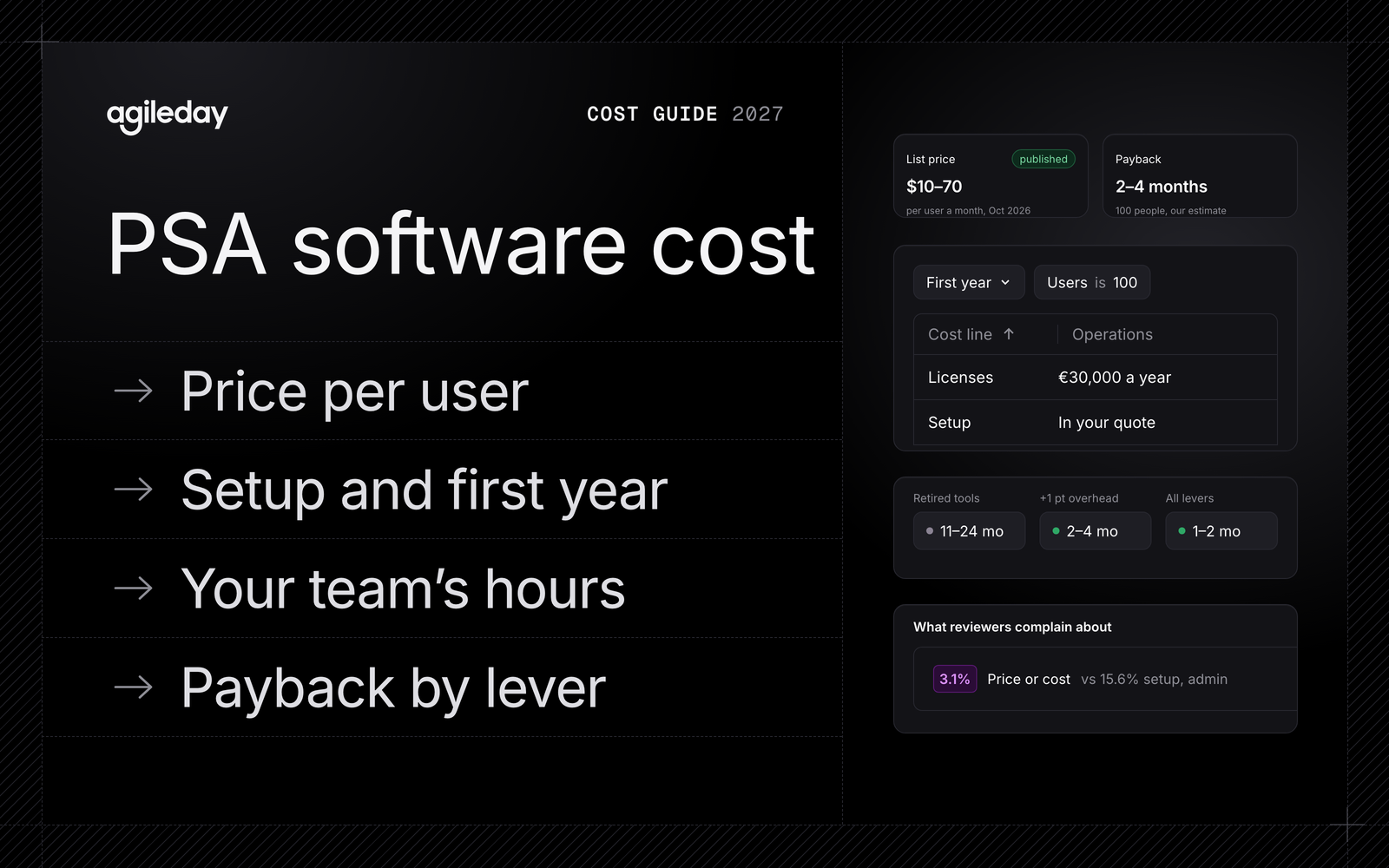
PSA software lists at about $10 to $70 per user per month, but the license is rarely what decides the first-year bill. Here is what setup, integrations, AI, and your own team's time add, with estimates for firms of 50 to 500 people and how long the investment takes to pay back.
Vendors that publish prices list PSA software at about $10 to $70 per user per month, and enterprise suites sell on quote. That number is the easy part. By our estimate, one-time setup alone adds about 8% to 50% to the first year's licenses, and integrations, AI usage, and the hours your own team spends come on top.
Cost is one of the first questions consultancies ask us, often on the very first call. This guide gives the numbers I would want as a buyer: list prices, the five cost lines, estimates for a first year at 50, 100, 200, and 500 users, how long it takes to pay back, and the questions to put to every vendor. Agileday makes one of the products listed, and our own prices are on the pricing page.
We’ll show you also pay-back figures and ROI calculations on this article.
How much does PSA software cost per user?
PSA vendors that publish prices list them at about $10 to $70 per user per month. Enterprise suites such as Kantata, Certinia, NetSuite, and Workday are quote only, and PSA modules of ERP suites can cost more. Where your firm lands depends on the modules you need, who counts as a paid user, and whether you pay annually or monthly.
List prices as of Oct 2026.
| Tool | Public entry price per user per month | Notes |
|---|---|---|
| Teamwork.com | $9.99 (free up to 5 users) | PSA features in quote-only tiers |
| Productive | $10 | Top tier quote only |
| Ruddr | $14 billed annually, $17 monthly | Billable users only, 24-month price lock |
| Agileday | €15 / $18 (Core), €25 / $29 (Operations) | AI and the Agileday Agent included in both; one-time setup fee |
| Scoro | €15 to €52 | Minimum 5 users; add-ons extra |
| BigTime | $20 | Higher tiers quote only |
| Rocketlane | $49 to $69 billed annually | Minimum 5 users; AI Fills add-on $29 per user |
| Kantata, Certinia, Accelo, NetSuite, Workday | Quote only | Expect partner fees for Certinia and NetSuite |
Quote only doesn't mean cheaper. In the evaluations we take part in, quotes from enterprise suites typically come in at 2 to 3 times our list price.
Prices differ for four reasons. Tiers decide whether time, billing, and finance are in the price or a step up. Vendors count users differently, from everyone in the company to billable people only. Volume lowers the price per user, so 1,000 users cost less per head than 100. And annual billing usually costs less than monthly, from about 13% to about 29% less at vendors that publish both prices. Compare quotes on the same users and the same modules, or the cheapest number will mislead you.
The full tool-by-tool comparison is in the best PSA software guide.
What else goes into the first-year cost?
Five lines decide what the first year costs: licenses, one-time setup and data migration, integrations, add-ons and AI usage, and the hours your own team spends. The license is the only line most vendors publish. Ask for the other four in writing before you compare.
| Cost line | What drives it | Typical size (estimate) | Ask the vendor |
|---|---|---|---|
| Licenses | Users × price × 12, plus the tier you need | $10 to $70 per user per month at list price | Who counts as a user, and what is in each tier? |
| Setup and data migration | Number of entities, data quality, how many old tools you import | 1 to 6 months of license fees for vendor-led onboarding (our estimate); 1 to 2 times the annual subscription for enterprise suites (Monetizely) | Is it a fixed fee, and what exactly does it cover? |
| Integrations | CRM, finance, HR, and payroll connections | Ready-made connectors are often included; custom builds run $5,000 to $50,000 or more each | Which connectors are ready-made, and who maintains them? |
| Add-ons and AI usage | Modules outside the tier, AI credits or tokens, extra environments | From zero to a metered monthly bill | Is AI in the seat price or metered? |
| Your team's time | Project owner, finance lead, admin hours | See the hours table below | Who on the vendor side does the work, and who on ours? |
The hidden lines are where buyers get hurt, not the price. In our analysis of 1,026 recent G2 reviews across 11 PSA products, 32 reviews (3.1%) named price or cost as a dislike. Five times as many, 160 reviews (15.6%), named onboarding, setup, or admin burden. The license gets the negotiation, but setup and admin decide whether the year goes well.
Users complain about setup five times as often as about price. Agileday analysis of 1,026 G2 reviews, Oct 2024 to Oct 2026.
At Agileday, the one-time setup fee covers onboarding and data migration. It depends on the scope of your setup, and we confirm it in your quote.
What does PSA software cost for a firm of 50, 100, or 500 people?
For a 100-person firm, our estimate for the first year, licenses plus one-time setup, runs from about $20,000 at an entry price point to about $108,000 at the upper published price point. Quote-only enterprise suites are not in the table, because their license prices are not public. Your own team's hours come on top.
First-year licenses plus one-time setup, estimate:
| Users | Entry price point ($15 per user) | Mid price point ($30 per user) | Upper price point ($60 per user) |
|---|---|---|---|
| 50 | $9,800 to $10,500 | $21,000 to $24,000 | $45,000 to $54,000 |
| 100 | $19,500 to $21,000 | $42,000 to $48,000 | $90,000 to $108,000 |
| 200 | $39,000 to $42,000 | $84,000 to $96,000 | $180,000 to $216,000 |
| 500 | $97,500 to $105,000 | $210,000 to $240,000 | $450,000 to $540,000 |
At 100 users, the license is most of year one, and setup adds 1 to 6 months of fees. Agileday estimate.
How we built it: three price points across the published range, 12 months of licenses at list price, and a one-time setup of 1 to 2, 2 to 4, and 3 to 6 months of license fees as the price point rises. It leaves out add-ons, AI usage, and custom integrations, which vary too much to average. For quote-only suites, add an implementation of 1 to 2 times the annual subscription, the range a procurement guide by Monetizely gives for enterprise PSA. Because the table uses list prices, it is the ceiling at larger sizes; see why the price per user falls as you grow.
At Agileday's list prices, a 100-person consultancy pays €30,000 ($34,800) a year for Operations or €18,000 ($21,600) for Core, before the one-time setup fee.
| Users | Core, per year | Operations, per year |
|---|---|---|
| 50 | €9,000 / $10,800 | €15,000 / $17,400 |
| 100 | €18,000 / $21,600 | €30,000 / $34,800 |
| 200 | €36,000 / $43,200 | €60,000 / $69,600 |
| 500 | €90,000 / $108,000 | €150,000 / $174,000 |
These are list prices on the Business plan. Agileday also offers custom pricing depending on company size and what we build with the customer, and Enterprise plan pricing is always custom.
Agileday setup fee depends on the client specific implementation and it can vary a lot. Speak with us first so we can propose you the best possible implementation with costs going forward.
At around 50 people, a lighter tool can cost less and do the job; see when a cheaper tool is the better buy.
Why does the price per user fall as you grow?
List prices are a ceiling. Most PSA vendors discount for volume, so 1,000 users cost less per head than 100. On our estimate, a firm with 10 times the users pays about 8 times the license bill, not 10 times.
Volume discount at the mid price point, estimate:
| Users | Discount off list (estimate) | Price per user per month at a $30 list price | Licenses for 12 months |
|---|---|---|---|
| 50 | None | $30 | $18,000 |
| 100 | 0% to 5% | $28.50 to $30 | $34,200 to $36,000 |
| 200 | 5% to 10% | $27 to $28.50 | $64,800 to $68,400 |
| 500 | 10% to 20% | $24 to $27 | $144,000 to $162,000 |
| 1,000 | 15% to 25% | $22.50 to $25.50 | $270,000 to $306,000 |
The license bill grows more slowly than headcount. Agileday estimate of volume discounts at a $30 list price.
How we built it: no discount below 100 users, then a discount off list that rises to 15% to 25% at 1,000 users, applied to the $30 mid price point. The band is our estimate. Published benchmarks for other business software point the same way: VendorBenchmark, a software negotiation adviser, lists 15% to 30% off list at 100 to 499 seats and 25% to 40% at 500 to 1,999 seats for Salesforce Sales Cloud. Contract length and timing move the discount too.
What your own team's time adds
Plan for 160 to 320 hours of your own people's time to roll out a PSA at 100 users, and 3 to 6 hours a week of admin after go-live. Most of it goes to cleaning skills and project data, agreeing on rate cards and project types, and testing the finance connection.
| Users | Your team's rollout hours (estimate) | Admin hours per week after go-live (estimate) |
|---|---|---|
| 50 | 110 to 220 | 2 to 4 |
| 100 | 160 to 320 | 3 to 6 |
| 200 | 260 to 520 | 5 to 10 |
| 500 | 560 to 1,120 | 11 to 22 |
Ask each vendor who does the data cleanup and mapping. When the vendor does it, the setup fee is higher and your hours are lower, which is usually the cheaper trade.
Who counts as a paid user?
PSA vendors count users differently, from everyone assigned to a project to billable people only. Check how each one counts subcontractors, candidates, and occasional users before you compare prices, because the user count moves the total as much as the per-user price.
At Agileday, users are all employees and subcontractors assigned to a project. Ruddr charges for billable people only. Ask every vendor the same three questions:
- Do subcontractors and freelancers need a paid seat?
- Do recruitment candidates, alumni, or bench profiles count as users?
- Do finance staff, executives, or read-only viewers need a full license?
Can you start small and add modules later?
Most PSA vendors sell in tiers or modules, so you can start with resourcing and skills and add time, billing, and finance once people trust the data. Starting small lowers the first-year bill and the risk, but check the price of moving up before you sign.
At Agileday, Core covers talent, skills, and resourcing at €15 / $18 per user per month. Operations adds time reporting, project financials, forecasting, billing, and revenue recognition at €25 / $29. HR (€5 / $6 per user per month), the Vendor portal (from €1,000 / $1,190 per month), and Integrations as a Service (from €100 / $119 per month) are add-ons.
Phasing works best when the first phase is the part that is less business critical. Skills and resourcing can go live while invoicing still runs in the old tool, so the switch never stops cash flow.
What can a PSA replace, and how do you compare it with your current tools?
Add up what you pay today for the tools the PSA will switch off in its first year, such as a time tracker, a resource planner, a CV tool, and the spreadsheets around them. Compare that total, not the per-user price alone.
Count only the tools you will actually retire, with a date. A saving that depends on switching off a tool "later" is not a saving in year one, and it is the line boards challenge first.
Two more lines are easy to miss. When consultants stop logging in to the ERP or CRM for time and project data, some of those seats can go. And the hours spent copying data between tools fall away, which shows up in the admin line, not the license line. The split between PSA and ERP is covered in PSA vs ERP: which does your services firm actually need.
How long does a PSA take to pay back?
Divide the first-year cost by the monthly value of three levers: tools you retire, overhead time that moves to customer work, and growth from a higher win rate and utilization. On our estimate, built on the values Agileday publishes, a 100-person firm on Operations pays back in about 2 to 4 months counting retired tools and one point of overhead.
Payback in months = first-year cost ÷ (yearly value ÷ 12). The cost side is above. The value side comes from three levers, and they show at different speeds:
| Lever | When it shows | Yearly value at 500 people | Scaled to 100 people |
|---|---|---|---|
| Point tools retired | Immediately | €0.1–0.2M | €20,000 to €40,000 |
| 1 percentage point of overhead moved to customer work | In weeks | €0.5–0.7M | €100,000 to €140,000 |
| Win rate 3 points higher and utilization 1 point higher | In months | €0.6–1.0M | €120,000 to €200,000 |
Payback for a 100-person firm on Agileday Operations, estimate:
| What you count | Yearly value | Payback on a first-year cost of €35,000 to €40,000 |
|---|---|---|
| Retired tools only | €20,000 to €40,000 | about 11 to 24 months |
| Retired tools and 1 point of overhead | €120,000 to €180,000 | about 2 to 4 months |
| All three levers | €240,000 to €380,000 | about 1 to 2 months |
Payback depends on what you count. Midpoints of our estimate, built on the 500-person model on agileday.com/solutions.
How we built it: the yearly values are the model on our solutions page for a 500-person firm, scaled to 100 people in proportion to headcount. The first-year cost is Operations at list price plus a setup estimate of 2 to 4 months of fees. Because cost and value both grow with headcount, payback is about the same at 50 or 500 people. The table assumes the value starts on day one, and the growth lever takes months to show, so count it last. It also leaves out your own team's rollout and admin hours, which you can add from the hours table above.
The license-only view is the honest floor: retired tools alone pay back a PSA inside the first year only at the top of the range. The return comes from the hours.
The growth lever is the largest because the gap is large. In SPI Research's 2026 benchmark, the top 20% of professional services firms run at about 91% utilization of available hours, against 79% for the average firm. They win 57% of their bids, against 45%, and keep 45% project margin, against 33%. Closing even a small part of that gap is worth more than any license saving.
The gap between the average firm and the top 20%. SPI Research, PS Maturity Benchmark 2026.
Where the hours come back
In our model of a 500-person IT consultancy, non-billable sales, general, and admin work takes 15.56% of all work, or 77.8 full-time people. One point of overhead is a small share of that. Agents in Agileday take on the operational work between sales, staffing, and finance, and the return shows up in three ways:
- Speed: the agent reads a new RFP and drafts the team: roles, openings, the best-matched candidates, and a margin forecast at your rate cards, writing nothing without your approval. The first team plan takes minutes instead of hours, so a proposal with the right team can go out in about two hours instead of "we'll come back tomorrow".
- Efficiency: tailored CVs for a bid are ready about 15 minutes after the RFP lands, instead of taking an evening. A health check across every deal you own, which flags date conflicts, double-booked candidates, and openings with no candidate, runs in a minute or two.
- Quality: work that rarely got done at all. Candidates are matched to each skill requirement in the RFP, not to a role title, and you can compare several what-if scenarios on revenue, billing ratio, and bench before you decide.
Efficiency, speed, and quality, before and after agents. Examples from the Agileday webinar of Nov 10, 2026.
Measure a baseline before you go live
Write down five numbers before go-live: utilization, the hours spent on staffing and reporting each week, proposal turnaround, win rate, and what you pay for the tools you will retire. Count a lever only when you can compare it with its baseline after 3 and 6 months.
To size the utilization lever for your own firm, multiply consultants × billable hours a year × 1% × average hourly rate. At 100 consultants, 1,600 hours, and €100 an hour, one point of utilization is worth €160,000 a year.
Which contract terms change the price?
Minimum seats or fees, commitment length, price increases at renewal, and billing frequency change the total as much as the list price does. Get each one in writing before you compare quotes.
- Minimum seats or fee: Scoro and Rocketlane publish a minimum of 5 users. Ask for any minimum before the first call ends.
- Commitment length: one year, or multi-year with a discount.
- Volume: ask for the price per user at your size today and at the size you plan to reach, so growth lowers the price without a new negotiation.
- Price at renewal: Ruddr publishes a 24-month price lock. Ask every vendor for a cap on increases.
- Billing: annual billing is usually cheaper than monthly; check what it does to your cash flow.
- Timing: match the start date to your budget year and to the renewal date of the tool you are replacing, so you don't pay for both.
Are AI, API, and MCP access included?
Ask each vendor whether AI is in the seat price or metered by credits or tokens, because metered AI makes the yearly cost hard to predict. The same goes for API and MCP access, which some vendors keep in higher tiers.
As of Oct 2026, Scoro includes a monthly allowance of AI credits per user, Teamwork.com moves to usage-based AI credits in November 2026, and Rocketlane sells AI Fills as a $29 per user per month add-on. At Agileday, AI and the Agileday Agent, the REST API, and standard integrations are included in both the Business and Enterprise plans.
When a cheaper tool is the better buy
If your firm has fewer than about 50 people, or you need one job done, such as time tracking or a shared planner, a point solution or an all-in-one agency tool will cost less. That is the right buy until the data you need sits in several tools.
Point solutions such as Float, Cinode, and Harvest typically cover one part of the work, such as resource planning, CVs, or time tracking, which can leave data disconnected and lead to complex integrations. All-in-one agency solutions such as Accelo, Productive, and Scoro are mainly aimed at smaller businesses and may not work at a larger scale. Agileday serves firms with 50 to 10,000 people. You can see every category side by side on the comparison page.
Frequently asked questions
Some vendors offer a free plan for very small teams, such as Teamwork.com, which is free for up to 5 users. Free plans cover project and time basics, not resourcing, billing, and finance in one system. Most PSA vendors offer a free trial instead, so you can test with your own data before you pay.
Enterprise PSA suites sell on quote, so there is no public list price. A procurement guide by Monetizely puts their implementation at 1 to 2 times the annual subscription, on top of the license. Ask every vendor for a first-year total in writing, with setup, integrations, and AI usage included.
Our estimate is 1 to 6 months of license fees for vendor-led onboarding. For enterprise suites, a procurement guide by Monetizely puts it at 1 to 2 times the annual subscription. Data quality, the number of entities, and custom integrations move the number most. Your own team's hours come on top of the fee.
Almost every PSA vendor prices per user per month. Some add fixed monthly fees for modules such as a subcontractor portal or integrations. Check who counts as a user, because billable-only pricing and everyone-in-the-company pricing give very different totals at the same per-user price.
Most do. List prices are a ceiling, and the price per user usually falls as the user count grows and the commitment gets longer. On our estimate, 1,000 users pay about 8 times the license bill of 100 users, not 10 times. Agileday also offers custom pricing depending on company size and what we build with the customer.
Put every quote on the same basis: the same users, the same modules, 12 months, plus setup, integrations, and AI usage. Add the tools each quote lets you retire. Then compare first-year and second-year totals, because one-time fees make year one look worse than the years after.
They can. Few vendors publish a renewal cap; Ruddr is one, with a 24-month price lock. Ask for the cap on increases in the contract, and note when your current tool renews so you don't pay for two systems at once.